
On Storytelling
Exhibition design in Hong Kong is often high profile. There are big launches and big names. Most of the time, though, it feels to me like it leaves little emotional impact or room for personal interpretation. My training in museum exhibitions has always been about the object story: designing an exhibition that tells the story of an object and of the collection it belongs to. When the object leads, visitors feel something, because the thing in front of them is real and historic, and it carries the traces of time.
In Hong Kong, I tend to see exhibitions come about in one of two ways. Some are made in-house by a museum’s own team. Others are commissioned from outside parties, with an emphasis on interactivity. That route often needs technology but offers little to learn from. A screen that responds to a touch is not yet a story.
Storytelling as a buzzword
I have been working with European firms ever since I started in exhibition design. In that tradition, a story is framed through emotional impact and theatre techniques.
In Hong Kong exhibition design, I hear the word “storytelling” all the time, and it has become a buzzword among many curators. The “stories” I see are usually information layered with historical references, and they have little to do with the everyday lives of ordinary visitors. A timeline is not a story! A story should answer a simple question: why should anyone care?
What makes a story
Margaret Atwood’s short story “Happy Endings” (1983) makes a point I relate to. She writes the same couple, John and Mary, in several versions, and the ending is always the same: they die. So the ending is not where a story lives. What matters, she says, is not What but How and Why. In other words, it is the beginning and the middle, and who chooses to tell them.
Try it with The Three Little Pigs. The usual opening is “Once upon a time there were three little pigs”, which makes the pigs our protagonists before anything happens. Begin with the wolf instead, three days hungry on a cold road, and we meet a different story. Begin with a bundle of straw, still damp from the field, and the story is about building, not about a threat. Nothing about the plot changes. What changes is where the teller stands, what the listener hears first, who is involved, and where it takes place. A story begins with the imagination of the person telling it.
Many Chinese tellings begin differently: “A long time ago, there was a man, known for this and that...” Or there is the old storyteller’s "話說", “it is said that”. The teller is not imagining a scene. They are passing along something heard before, and the shape of the telling follows how it was first received. It is retelling, in the older sense of the word.
I don’t think one is better. But the difference matters in an exhibition. Visitors walk into a room, and the first thing they see, hear or touch is the opening line. If it is a timeline, they have been told something. If it begins with one person, one object, one moment, they have been invited in.
That is the question I want to carry to Europe: where does the story begin, and who is standing in front of it?
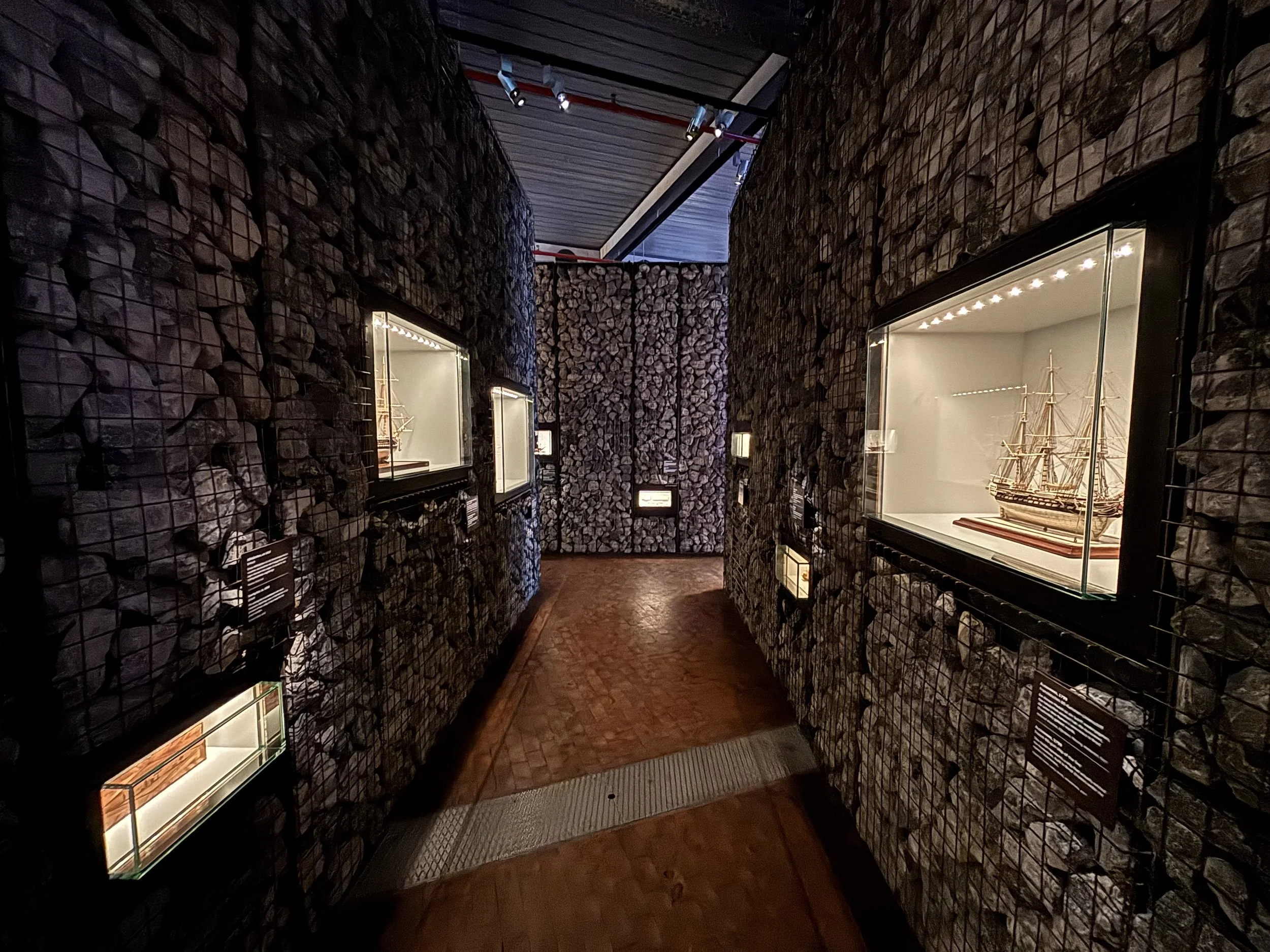
At the Deutsches Technikmuseum Berlin @Schifffahrt.
One approach in exhibition design is “no design”: let the object lead the story. In this museum gallery, two materials were enough. They shaped the space and set its mood, with no need for elaborate showcases that cost a fortune to build. The models sit in lit, glass-fronted niches, and the eye goes straight to them.
What makes it powerful is not the so-called interactives. It is the confidence to let the objects speak for themselves. I love German design. It trusts the object, and it is rational with no bullish*t.
It also takes skill. “No design” is never really none. Choosing what to leave out, and how to light what remains, are some of the hardest design decisions to make.